

A Formal Introduction to Its Definition, Origins, and Enduring Artistic Value.
Fresco painting is one of the oldest and most resilient methods of wall decoration in the history of art. Although modern audiences may associate the term primarily with Renaissance masterpieces or ancient archaeological sites, the fresco techniquespans thousands of years and numerous civilizations. Its scientific foundation, refined craftsmanship, and architectural integration distinguish it from virtually every other painting tradition.
This article provides a formal, comprehensive introduction to what fresco is, what the term means, how the process works, and why the technique remains historically, aesthetically, and culturally significant.

The Meaning of “Fresco” and Its Technical Definition
Linguistic origins and conceptual foundation
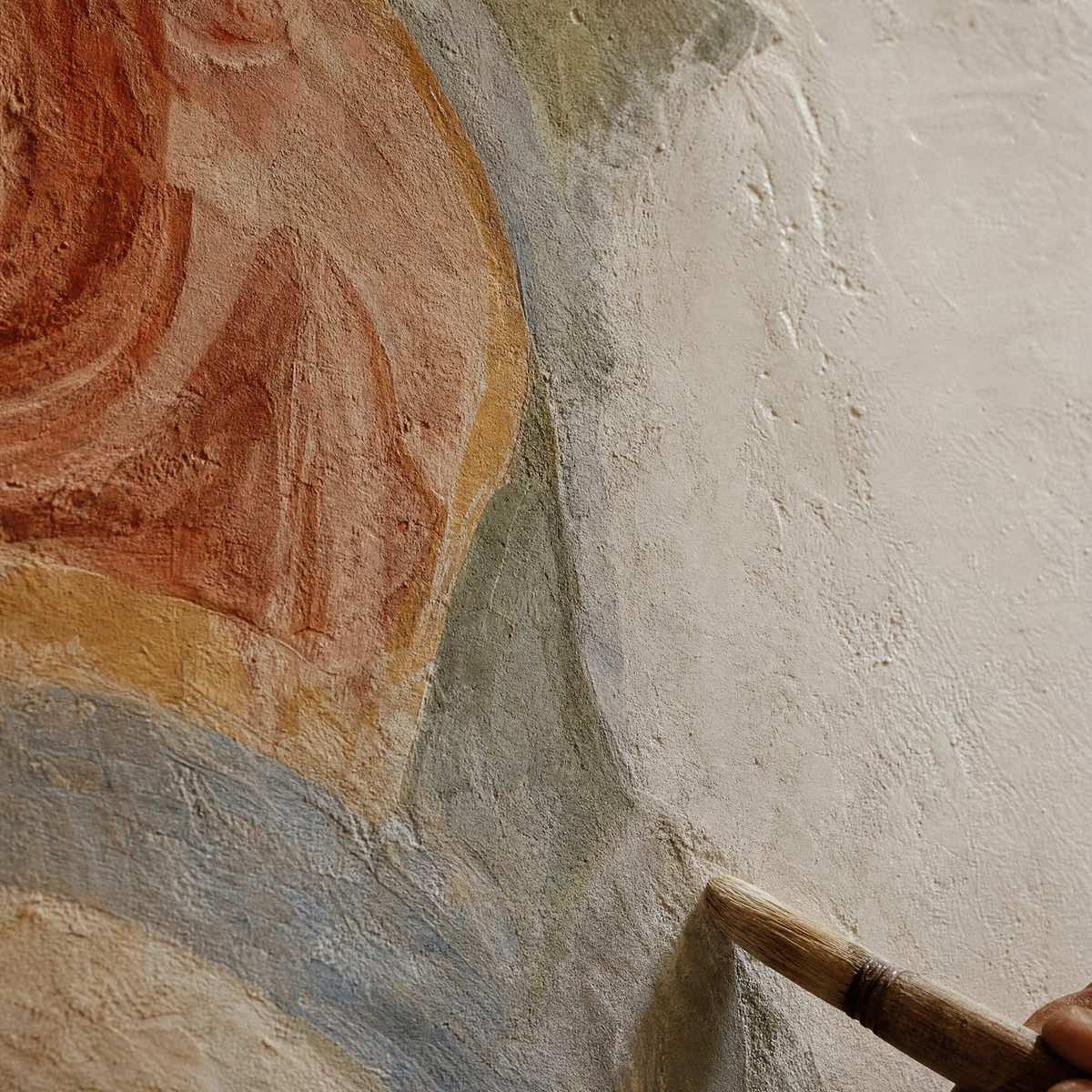
The word fresco derives from the Italian affresco, meaning “fresh.” This etymology refers specifically to the freshly applied wet plaster into which pigments are painted. From a technical standpoint: Fresco is a method of mural painting in which water-based pigments are applied to fresh lime plaster, producing a chemical bond between pigment particles and the plaster surface as it dries. This definition captures the essence of the method: the painting is not placed atop surface but becomes physically integrated with it. As the plaster cures, the wall and the image become one unified material.
Fresco as a time-dependent technique
Because the plaster must remain damp for the pigments to penetrate and bond, fresco painting is inherently time-sensitive. The area that can be completed in one working session is known as a giornata (“a day’s work”). Each giornata represents both a technical requirement and a structural element within the final composition. The need for strategic planning separates fresco from mediums such as oil or acrylic, which allow for indefinite reworking.
The Principal Types of Fresco Techniques.
Buon fresco — the classical and most durable method
Buon fresco, or “true fresco,” is the most historically esteemed form of the technique.
Here, the artist paints with pure mineral pigments suspended in water directly onto wet lime plaster. As the plaster carbonates—absorbing carbon dioxide from the air and crystallizing—the pigments become embedded within the surface.

Key advantages include:
-exceptional long-term stability
-resistance to humidity, flaking, and ultraviolet deterioration
-a distinctive matte luminosity
-suitability for large-scale architectural surfaces
Buon fresco is the technique used in major Renaissance cycles, including Michelangelo’s Sistine Chapel ceiling.
Fresco secco — painting on dry plaster
By contrast, fresco secco involves painting on dry plaster surfaces using pigments mixed with organic binders such as egg yolk, casein, gum, or glue. Although this method allows for detailed work and later adjustments, it is less chemically stable because the pigments rest atop the plaster rather than merging with it. Fresco secco was often used to refine details in works that were primarily executed in buon fresco.

Mezzo fresco — a hybrid method
Mezzo fresco occupies an intermediate position. It is painted on plaster that is no longer fully wet but retains a slight absorptive quality. While it provides more flexibility and working time, it does not achieve the same degree of permanence as buon fresco. Nonetheless, it was widely employed when large wall cycles required a balance between efficiency and durability.
Historical Development of Fresco Across Civilizations
Early fresco traditions of the ancient world
Fresco techniques have been documented in multiple ancient cultures.
Minoan civilization (Crete): Some of the earliest extant frescoes originate from the Minoan civilization (c. 2000–1400 BCE), particularly at Knossos and Akrotiri. Thesefrescoes depict marine life, rituals, and domestic scenes with fluid movement and naturalistic color, demonstrating advanced skill and aesthetic sophistication.
Ancient Egypt: Egyptian artists applied pigments to damp or dry plaster on tomb and temple walls. Although often categorized as fresco secco, these works reflect a close relationship between painting, architecture, and funerary practice.
Ancient Rome: Romans adopted and expanded fresco techniques extensively. At Pompeii and Herculaneum, remarkably preserved frescoes illustrate mythological scenes, landscapes, still life imagery, and trompe-l’œil architectural compositions. The Roman approach influenced later European mural traditions profoundly.
Medieval Europe — fresco as a didactic medium
During the Middle Ages, fresco became an essential element of church decoration. Large wall cycles illustrated biblical narratives, saints’ lives, and moral lessons intended for largely illiterate congregations. The technique’s clarity, durability, and integration with sacred architecture made it especially appropriate for ecclesiastical settings.
The Renaissance — the height of fresco innovation
The Italian Renaissance marked the pinnacle of fresco painting. Artists such as Giotto, Masaccio, Ghirlandaio, Michelangelo, and Raphael advanced the medium through innovations in perspective, anatomy, spatial composition, and narrative coherence.
Fresco became synonymous with monumental public art. Entire chapels and civic buildings were transformed into environments that communicated theological, philosophical, and political ideas through vast pictorial cycles. The technique demanded rigorous drawing, mastery of color, and precise coordination among artisans.
Scientific Principles and Material Structure of Fresco
Carbonation — the chemical foundation of fresco durability
The key scientific process in buon fresco is carbonation, wherein calcium hydroxide in the plaster reacts with atmospheric carbon dioxide to form calcium carbonate. This reaction transforms soft, workable plaster into a stone-like surface that permanently entraps the pigment.
This process explains why frescoes:
-maintain stable color over centuries
-resist flaking and peeling
-withstand moisture and temperature fluctuations
-survive environmental conditions that damage other mediums
Structural layers of a fresco wall
A traditional fresco consists of multiple layers:
1. Arriccio — the rough base layer that provides structural support. Sinopia — an underdrawing executed in red pigment to outline the design. Intonaco — the smooth, final plaster layer to which pigments are applied. Pigments — earth and mineral pigments activated with water.
The sinopia layer is of particular scholarly interest because it reveals the artist’s compositional planning and often survives beneath detached fresco surfaces.
Natural mineral pigments and their visual qualities
Fresco pigments must be alkaline-resistant and stable in wet plaster. Common pigments include:
-iron oxides (reds, yellows, browns)
-charcoal (black)
-copper-based greens
-ultramarine (from lapis lazuli)
-various earth pigments
These minerals produce a harmonious, earthy palette and a matte finish that is characteristic of fresco surfaces. Their stability contributes to the technique’s longevity and distinctive visual presence.
Distinctive Characteristics of Fresco as an Artistic Medium
Integration with architecture
Fresco differs from panel and canvas painting because it is physically inseparable from the architectural surface. It interacts with light, spatial proportions, and the viewer’s movement. This architectural integration gives frescoes a monumental and immersive quality.Unique surface appearance Fresco surfaces exhibit a subtle, diffuse luminosity due to light penetrating the thin plaster layer before reflecting back to the viewer. This quality yields a visual softness and clarity unattainable through oils or acrylics.
Demanding technique that reflects artistic discipline
Because corrections are difficult or impossible on drying plaster, fresco requires meticulous planning, confident execution, and strong draftsmanship. The permanence of each brushstroke reflects both technical mastery and disciplined artistic intention.
Contemporary Relevance of Fresco
Preservation of cultural heritage
Frescoes are invaluable historical documents, offering insight into the beliefs, aesthetics, and daily life of past civilizations. Their durability allows them to serve as reliable visual records for scholars, historians, and conservators.
Continued use in modern art and architecture
While less common today due to the dominance of portable media, fresco remains a respected technique among contemporary muralists and conservation specialists. Its natural materials, sustainability, and integration with architecture align well with current interests in ecological and site-specific art.
Enduring aesthetic and cultural significance
Fresco endures because it embodies stability, craftsmanship, and a direct relationship between art and space. It links modern viewers with ancient practices and illustrates the continuity of human creativity across time. Fresco is more than a mural technique; it is a synthesis of chemistry, craftsmanship, design, and architectural integration. Its linguistic roots in the word “fresh” reflect a process defined by immediacy, precision, and deep material understanding. From ancient Crete to the Italian Renaissance and into the modern era, fresco has served as a durable and expressive visual language.Its longevity, formal clarity, and historical depth make fresco one of the most significant and enduring art forms in human history—an art form that continues to inform cultural identity.
Digital Fresco: Simulating Fresco Texture in Prints and Mixed Media
The Monumental Art: Fresco in Religious and Civic Architecture