

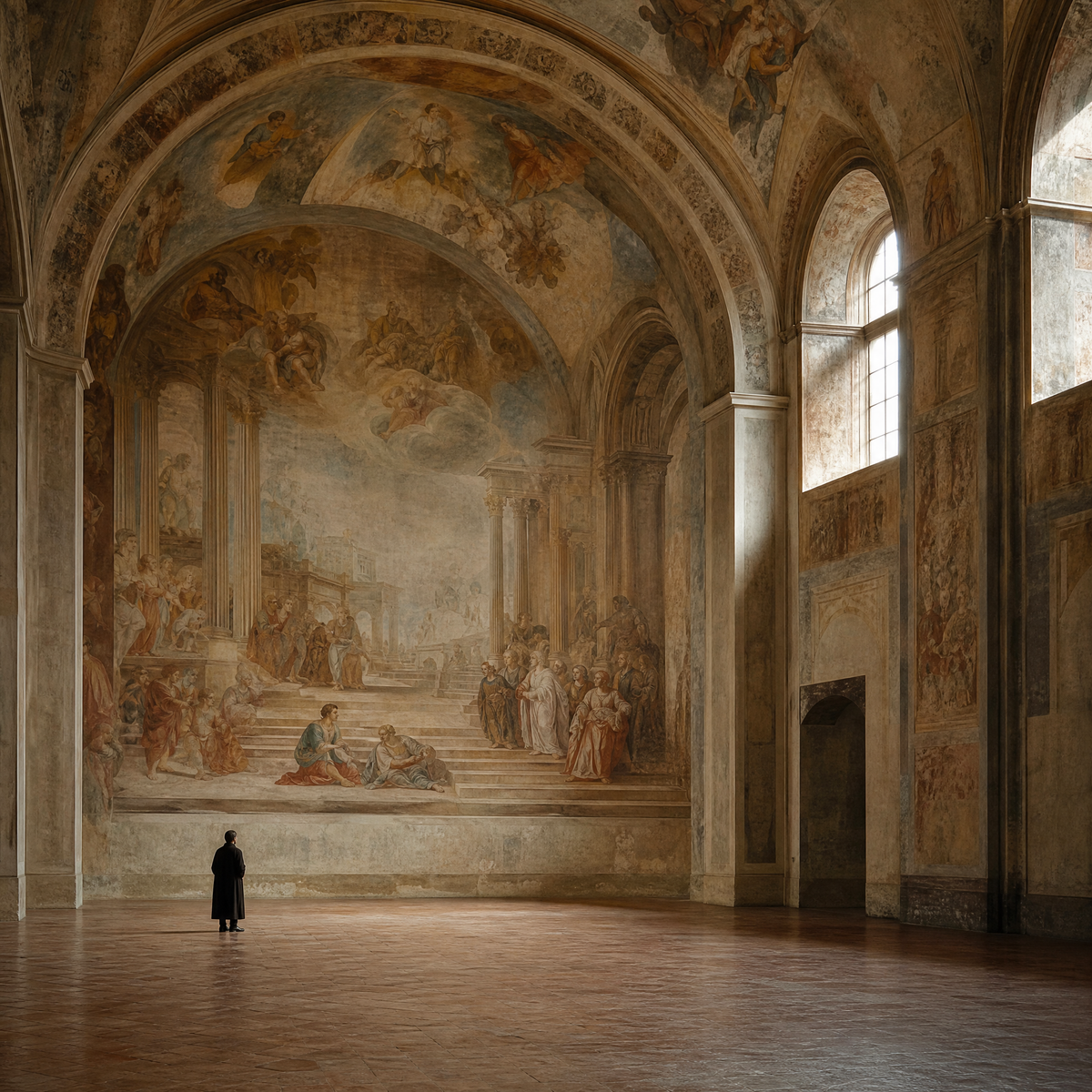
1. The Role of Fresco in Sacred and Public Spaces: Immersive Architectural Narratives
Fresco, the art of painting with mineral pigments directly onto wet lime plaster, served a dual and essential role in the history of art: it was the dominant medium for both religious devotion and civic authority. Its unique chemistry, which binds the artwork permanently to the structure, transformed churches, cathedrals, palaces, and town halls into monumental, immersive narratives.
Fresco was never merely decorative. It functioned as a communication tool, prestige marker, and political instrument, embedding spiritual and civic ideology into architecture for centuries. In sacred spaces, it conveyed theological truths and guided worship; in civic structures, it reinforced authority, governance, and cultural identity. The fusion of artistry, material science, and architecture ensured frescoes became integral components of both sacred and public environments.
2. Why Fresco Was the Medium of Choice for Public Commissions
Durability and Longevity: A Guarantee of Permanence
Fresco offered unparalleled durability. The carbonation process—where wet lime plaster reacts with atmospheric carbon dioxide to form calcium carbonate—ensures the pigments are chemically fused to the wall, creating a surface that can survive for centuries. For religious institutions or governments seeking to communicate authority and spiritual doctrine across generations, fresco was indispensable. Unlike panel paintings or tempera, which were vulnerable to warping, cracking, and environmental damage, frescoes became an enduring part of the architectural fabric.
Logistical and Economic Efficiency
Despite the high initial cost of commissioning large-scale frescoes, the medium proved economically advantageous over time. Frescoes required minimal long-term maintenance, avoiding repeated restoration needed for other media. The giornata system, where artists completed daily sections of wet plaster, allowed large projects to be organized efficiently. This workflow enabled workshops to manage extensive mural cycles, meeting the demanding timelines of papal, royal, or municipal commissions without sacrificing quality.
Visual Impact in Large Spaces: The Immersive Narrative
Fresco’s ability to cover walls, ceilings, and domes gave artists unmatched capacity for immersive storytelling. Large-scale murals could dissolve the perception of a flat surface, creating illusionistic architectural extensions. Cathedrals, civic halls, and palaces transformed into environments where viewers were surrounded by narrative, enhancing emotional, ceremonial, and pedagogical impact in a way impossible for smaller, detached paintings.
Symbolism, Prestige, and Propaganda
The technical complexity and permanence of frescoes inherently symbolized wealth, devotion, and cultural sophistication. Patrons—whether the Pope, a monarch, or city council—commissioned frescoes to reinforce institutional authority. In civic contexts, frescoes served as explicit visual propaganda, communicating moral ideals, societal values, and the divine or historical legitimacy of rulers.
3. Fresco in Religious Architecture: From Dome to Apse
In sacred architecture, frescoes mediated between the divine and the human, transforming physical structures into spatial reflections of celestial order.
Churches, Cathedrals, and Liturgical Spaces
Fresco cycles were meticulously aligned with architectural geometry and liturgical function:
-
Domes/Vaults: Depicted Christ Pantocrator, the Virgin Mary, or heavenly hosts, emphasizing cosmic significance.
-
Apses: Featured climactic narratives, such as the Crucifixion or Last Judgment, reinforcing doctrinal messages near altars.
-
Walls: Sequential narratives illustrated saints’ lives, parables, and biblical history.
The matte finish of fresco was particularly effective in dimly lit interiors. Candle and lamp light scattered softly across the surface, enhancing legibility, contemplation, and spiritual atmosphere.
Monastic and Pilgrimage Contexts
In cloisters, chapter houses, and pilgrimage sites, frescoes were didactic and devotional, instructing monks and pilgrims while reinforcing rules and spiritual reflection. These cycles became the “Bible of the Poor,” communicating narratives to largely illiterate audiences in visual form.
Early Christian and Byzantine Usage
Fresco began in Early Christian catacombs and became central to Byzantine architecture. In Orthodox churches, strict iconographic programs dictated figure placement, ensuring the frescoes created a theological cosmos integrated with the architecture. Continuous, large-scale frescoes were essential to the spiritual experience, enveloping worshippers in visual theology.
4. Fresco in Civic Architecture: Power, Politics, and Public Virtue
In secular architecture, frescoes shifted from theological to historical, political, and moral narratives, asserting state authority and civic virtue.
Palaces, Town Halls, and Government Chambers
Town halls and princely courts used fresco cycles to visualize principles of governance and civic morality:
-
Allegories of Rule: Depictions like Siena’s “Allegory of Good and Bad Government” highlighted the rewards of virtuous leadership versus the chaos of tyranny.
-
Historical Commemoration: Frescoes celebrated military victories, founding myths, and legislative achievements, creating shared civic memory.
-
The Intersection of Power: Permanent, costly, and public works reinforced the legitimacy of rulers and the stability of governmental authority.
Public Forums and Guild Halls
Fresco extended to hospitals, libraries, guild halls, and public fountains, educating citizens, commemorating service, and embedding art into daily urban life. These projects strengthened civic identity and cultural cohesion by integrating visual narratives into communal spaces.
Commissions, Economics, and Patronage
Large civic frescoes demanded organized workshops led by masters who negotiated patronage from elite families or government councils. These projects reflected both the economic prosperity and cultural sophistication of the city, providing a public showcase for artistic and political achievement.
5. Technical Integration and Legacy
Scale, Surface, and the Giornata System
Large-scale frescoes required architectural precision and disciplined workflow. Detailed full-size cartoons were used to transfer designs onto walls. The wall was divided into giornate, small daily plaster sections, requiring rapid, confident work. Each section became a technical and artistic module, collectively forming the monumental mural.
Environmental Design Factors
Patrons and architects collaborated to protect frescoes for longevity. This included optimizing natural lighting, wall thickness, and structural stability. Considerations such as minimizing direct sunlight, moisture exposure, and temperature fluctuation were crucial for preservation.
Global Legacy and Influence
Italian Renaissance frescoes (e.g., the Sistine Chapel, Arena Chapel) remain iconic, but the influence of civic and religious fresco extended globally:
-
Mexican Muralism (20th Century): Diego Rivera, José Clemente Orozco, and David Alfaro Siqueiros revived monumental fresco for public education and social commentary, demonstrating fresco’s enduring civic function.
-
Contemporary Public Art: Modern muralists adapt lime-based techniques to address civic issues, connecting today’s audiences to centuries of monumental tradition.
Frescoes in religious and civic architecture serve as living records, chronicling artistic, theological, and political histories. They remain central to conservation, architecture, and cultural studies, bridging past and present in immersive visual storytelling.
What is Fresco?
Fresco Studies on Paper: Using Hahnemühle for Cartoons and Color Tests