
Every important creative movement begins with a simple idea. Sometimes that idea appears suddenly — during a conversation, a moment of inspiration or an unexpected discovery. Other times, it develops slowly over years, shaped by experiences, relationships and a shared way of seeing the world. The story of Gito Art belongs to the second kind.
Before there was a project, before there was a name, before there was a presence at one of Bulgaria’s biggest pop culture events, there was something much more personal: a friendship. Vasil and Georgi have been best friends since childhood. Their connection was built over years of shared memories, conversations, dreams and experiences. Like many friendships that last through different stages of life, theirs developed through a common understanding of each other and a similar curiosity about the world around them.
Over time, that friendship became the foundation of a much larger idea — the belief that art should be experienced differently.
They did not want art to exist only in places where people traditionally expect to find it. They did not want creativity to be something separated from everyday life, something that people had to actively search for before they could discover it. They believed in something different: art should come closer to people. It should be visible. It should be accessible. It should create moments of connection between people who may never have entered a traditional gallery or museum.
This idea became the heart of Gito Art.

The project was born from a simple but powerful question: what happens when art leaves the spaces where we expect to find it and enters the spaces where people already are?
The answer, according to the vision of Gito Art, is that art becomes more alive. It becomes a conversation instead of only a presentation. It becomes an experience instead of only an object. It becomes something that belongs not only to artists and collectors, but to everyone.
For Vasil and Georgi, this was never only about displaying creative works. It was about changing the relationship between people and art.
Throughout history, art has played a central role in human culture. It has recorded civilizations, expressed emotions, questioned ideas and allowed people to communicate beyond words. From ancient paintings and sculptures to modern digital creations, art has always reflected the way people understand themselves and the world around them.
However, the way audiences experience art has changed dramatically in recent decades. The traditional image of someone quietly walking through a museum and observing artworks from a distance is only one part of the artistic experience today. Modern audiences increasingly seek interaction, participation and emotional connection. They want to understand the story behind a creation, communicate with creators and feel that they are part of something meaningful.
This transformation is exactly where Gito Art finds its purpose.
The project represents the idea that art does not have to be distant or intimidating. It does not have to belong only to specialists, collectors or people with previous knowledge of art history. Art can be discovered by anyone.
A person can encounter a work of art unexpectedly and still create a meaningful connection with it. Sometimes the most powerful artistic moments happen when people are not searching for them.
A visitor walking through an event. A person stopping because something catches their attention. A conversation that begins with a simple question. A child seeing something creative for the first time.
These moments represent the philosophy behind Gito Art. The project is based on the belief that creativity grows when it reaches people.

The Evolution of Comic Con: From Comics to a Global Celebration of Imagination
To understand why Gito Art’s participation at Aniventure Comic Con 2026 was so significant, it is important to understand the world of Comic Con itself.
Comic Con is no longer simply an event for comic book fans. Over the years, Comic Con has transformed into one of the most influential cultural movements in the world. What began as gatherings focused mainly on comic books gradually expanded into a celebration of almost every form of modern storytelling.
Today, Comic Con events bring together communities connected with comics, cinema, television, gaming, anime, fantasy, science fiction, cosplay, illustration, digital creativity, technology and visual storytelling.
The reason for this growth is simple: all of these worlds are connected by imagination.
A comic book character, a movie universe, a video game world or an original artwork all begin in the same place — the human mind.
Before audiences see a finished creation, someone has imagined it. Someone has designed it. Someone has transformed an idea into something that others can experience.
This is why Comic Con has become more than entertainment. It has become a cultural meeting point where creators and audiences meet directly.
Fans are no longer only consumers of stories. They become participants.
They dress as characters they admire. They meet actors who bring fictional personalities to life. They discover independent artists. They interact with creators. They become part of communities built around shared passions.
Comic Con represents a new understanding of culture — one where the boundaries between creator and audience become smaller.
And this is precisely why Gito Art belongs in this environment.
At first glance, contemporary art and pop culture may appear to be separate worlds. One is often associated with galleries and exhibitions, while the other is associated with entertainment, movies, comics and fandom.
But underneath the surface, they share the same foundation.
Both are about imagination. Both are about storytelling. Both are about creating emotional experiences.
A comic artist creates a universe through drawings. A filmmaker creates a universe through images and movement. A contemporary artist creates a universe through concepts, materials and ideas.
The tools may be different, but the purpose is similar: to make people feel something.
For Gito Art, Comic Con was not a departure from the world of contemporary art. It was an opportunity to show that contemporary art already belongs among these creative communities.

Aniventure Comic Con 2026: Where Different Creative Worlds Meet
In Bulgaria, Aniventure Comic Con has become one of the most important celebrations of popular culture, bringing together fans, artists, actors, influencers, creators and communities from many different backgrounds. The event creates a unique atmosphere where thousands of people gather because of their shared passion for imagination, storytelling and creativity.
Some visitors arrive because of cinema. Others come because of comics, gaming, anime, cosplay or the creators they admire. Some are passionate about fictional universes they have followed for years, while others come simply because they want to experience something different and become part of a larger creative community.
Despite these different interests, everyone becomes part of the same environment — one built around creativity.
Walking through Comic Con means moving through different worlds at the same time. One moment, visitors may encounter a familiar superhero universe. The next moment, they may discover an independent artist presenting original creations. They may meet an actor whose work they admire, watch a creator explain their process or discover an entirely new artistic perspective.
This diversity is what makes Comic Con unique.
It is not only a place where people consume culture. It is a place where culture is created, shared and experienced.
For Gito Art, this environment represented the perfect opportunity to continue the mission that started with Vasil and Georgi’s friendship: bringing art closer to people. Instead of waiting for audiences to enter traditional artistic spaces, Gito Art entered a space already filled with curiosity, creativity and openness.
The participation of Gito Art at Aniventure Comic Con 2026 represented a meeting point between two worlds that may seem different at first, but are connected by the same foundation — imagination.
Gito Art at Comic Con 2026: Transforming a Stand Into an Artistic Experience
When Gito Art became part of Aniventure Comic Con 2026, the goal was not simply to create another exhibition area. The intention was to create a place where people could stop, explore, interact and become part of the creative process.
In many traditional exhibitions, the relationship between visitors and artworks is often based on observation. A person enters a space, looks at the creations presented and leaves with their own interpretation.
Gito Art approached the experience differently.
The idea was to create a connection.
Visitors who came to the Gito Art space were not simply viewers. They became participants in a creative environment where curiosity, conversation and interaction were equally important parts of the experience.
This approach reflects one of the biggest changes happening in contemporary culture today. Audiences are no longer interested only in seeing something. They want to understand it. They want to experience it. They want to know the people behind it and the story that created it.
A work of art can be impressive because of its appearance, but the memory of discovering it can make it even more meaningful.
A conversation with an artist can become as important as the artwork itself. A moment of surprise can become part of the story.
This was exactly the atmosphere that Gito Art wanted to create at Comic Con — a place where creativity was not distant, but approachable.
The environment of Comic Con itself helped strengthen this connection. Unlike traditional cultural spaces where visitors often move quietly from one artwork to another, Comic Con is built around energy, participation and shared experiences. People come to communicate, exchange ideas and celebrate creativity together.
This made it the perfect environment for a project focused on interaction.
Gito Art became part of a larger conversation about how creativity exists today — not only inside galleries, museums or exhibitions, but everywhere people gather around ideas.

The Importance of Interaction: When Visitors Become Part of the Artistic Story
One of the strongest ideas behind Gito Art is that art becomes more powerful when people feel connected to it.
A visitor does not always need to know complex artistic terminology or understand every detail of a concept in order to experience something meaningful. Sometimes the first step is simply curiosity.
A question.
A reaction.
A moment of discovery.
This is especially important when introducing contemporary and conceptual art to wider audiences.
For many people, contemporary art can sometimes feel distant because they believe they need special knowledge to understand it. Gito Art challenges this idea by showing that the first and most important connection with art is personal.
Everyone experiences creativity differently.
One person may notice the visual aspect of an artwork. Another may focus on the story behind it. Someone else may connect with the idea or emotion that the creation represents.
There is no single correct way to experience art.
This openness is one of the reasons why bringing art into environments like Comic Con is so meaningful.
Visitors arrive with different interests and backgrounds, but they share one important quality: curiosity.
Someone who comes to Comic Con because of films, gaming or comics may unexpectedly discover an interest in contemporary artistic expression. A young visitor may see creativity from a completely new perspective. A collector may discover another form of artistic value. A person who never planned to explore contemporary art may leave with a new appreciation for it.
This is how artistic communities grow.
Not by creating barriers.
By creating invitations.

The Wheel of Luck: Creating Memorable Moments Through Play and Connection
A particularly engaging part of the Gito Art experience at Comic Con was the interactive element created through games and activities. Among the highlights was the Wheel of Luck, which added a playful and exciting dimension to the visitor experience.
At first glance, a wheel may seem like a simple game. However, within the philosophy of Gito Art, it represented something much larger.
It transformed visitors from observers into active participants.
Instead of simply looking at what was presented, people could become directly involved in the atmosphere surrounding the project.
The anticipation before spinning the wheel, the excitement of discovering the result and the possibility of receiving a surprise created shared moments between visitors and the Gito Art team.
These small moments are often what people remember most from events.
Not only what they saw.
But what they experienced.
The Wheel of Luck helped create exactly this type of experience — one built around interaction, emotion and participation. Visitors who joined the activity had the opportunity to receive prizes connected with the Gito Art presence, making their experience more personal and memorable.
The prizes became more than simple gifts. They became reminders of a moment shared during Comic Con and a symbol of the connection created between the project and its visitors.
The idea behind the activity was simple: people should not only leave Comic Con remembering that they saw Gito Art.
They should leave feeling that they were part of it.
This combination of creativity and playfulness reflects an important direction in modern cultural experiences. Today, successful artistic and cultural projects increasingly understand that audiences want involvement.
They want to participate.
They want to contribute.
They want moments that feel personal.
Gito Art embraced this idea by creating an environment where art, entertainment and human connection could exist together.
The Visitors: The Heart of Every Creative Experience
No cultural event exists without people.
Behind every successful exhibition, festival or creative project are the audiences who give it meaning. For Gito Art, visitors were not simply numbers or spectators. They were the reason behind the project’s philosophy.
The entire idea of bringing art outside traditional spaces comes from the desire to reach real people in real environments.
At Comic Con, this meant connecting with a diverse audience — fans of different ages, interests and backgrounds who all came together because of creativity.
Some visitors may have already been familiar with contemporary art. Others may have encountered this type of expression for the first time.
But everyone had the opportunity to engage with the project in their own way.
This is one of the most important roles of events like Comic Con: they create unexpected encounters.
They allow different communities to meet.
A comic fan can discover an artist.
A gamer can discover a new form of storytelling.
A movie enthusiast can discover visual creativity beyond cinema.
A person who never planned to explore contemporary art can suddenly find themselves interested in it.
These connections are exactly what Gito Art aims to create.
Continuing from “These connections are exactly what Gito Art aims to create.”:

The Creators Behind the Vision: Vasil and Georgi’s Journey
The story of Gito Art cannot be separated from the story of the two people who created it. Behind every artistic project there is a personal motivation, a belief and a reason why the idea needed to become reality. In the case of Gito Art, that foundation comes from the lifelong friendship between Vasil and Georgi.
Their journey shows how powerful ideas can grow from genuine relationships. What started as childhood conversations and shared interests gradually developed into a much larger creative vision. Their friendship became the place where ideas could be exchanged freely, where imagination could grow and where new possibilities could be explored.
Being friends since childhood gave them something incredibly valuable — a deep understanding of each other. They knew each other’s perspectives, strengths and ways of thinking. This connection became an important part of building Gito Art because creating something meaningful requires more than just an idea. It requires trust, patience, commitment and the ability to continue moving forward together.
Their vision was based on a simple but powerful belief: art should not remain hidden behind walls. It should move closer to society. It should become part of people’s everyday experiences and reach audiences who may not normally search for artistic spaces.
For Vasil and Georgi, Gito Art is not only a creative project. It is a reflection of their shared values and their desire to create something that connects people.
They believe that art becomes stronger when it is experienced together. A creative work can inspire a conversation, create a memory or introduce someone to a new perspective. The value of art is not only found in the object itself, but also in the emotions and connections it creates.
This philosophy is what continues to guide Gito Art’s development.
Special Guests: Bringing Different Creative Worlds Together
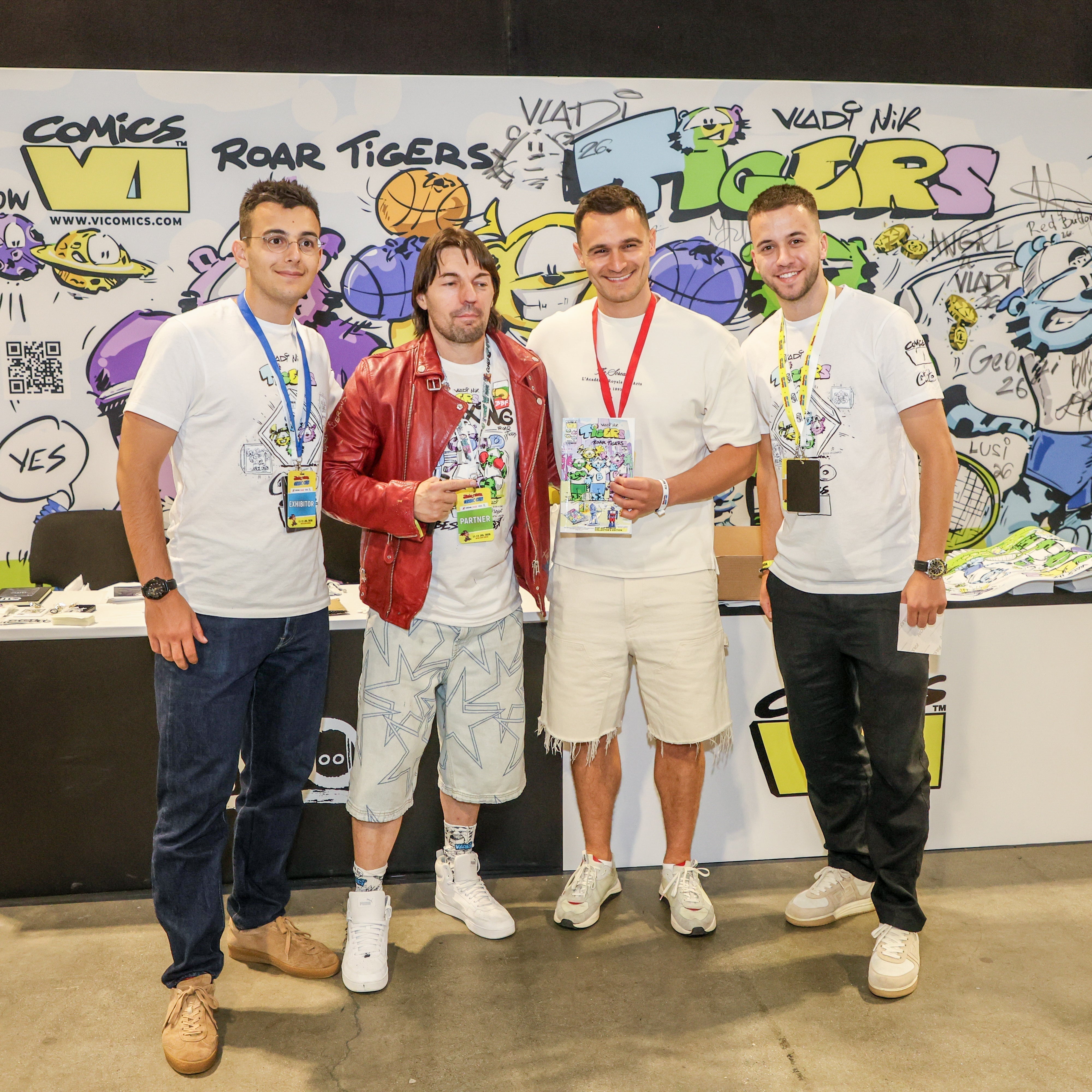
One of the important highlights of the Gito Art presence at Aniventure Comic Con 2026 was the connection with special guests who represent different areas of modern creativity.
Among the guests who visited and interacted with the Gito Art experience were Atanas Mishev, one of Bulgaria’s recognizable influencers known for his humorous videos, as well as actors Alexander Sano, Julian Kostov and Maya Paunovska.
Their presence added another important dimension to the project because it demonstrated how different creative worlds can meet in one place.
Today, creativity is no longer limited to one specific field. Art, cinema, social media, entertainment and storytelling constantly influence each other. A person can create an emotional connection with an audience through a painting, a film performance, a digital video or a fictional universe.
The modern creative landscape is built on these connections.
Atanas Mishev represents the power of digital content and the way social media has changed communication between creators and audiences. Through humour, personality and direct interaction with followers, digital creators have become an important part of modern culture.
Alexander Sano, Julian Kostov and Maya Paunovska represent another side of creativity — the world of acting and storytelling. Through their work, actors bring characters, emotions and stories to life, creating experiences that connect with audiences.
Although their creative paths are different, they all share the same foundation as Gito Art: the ability to create emotions and build connections.
Their involvement at the event reflected the spirit of Comic Con itself — a place where artists, performers, creators and fans come together in the same environment.
The presence of such guests also showed that contemporary art does not exist separately from popular culture. Instead, it is part of a much larger creative ecosystem where different forms of expression influence and inspire each other.
ART VLADI and the Creation of New Creative Worlds
An important part of the wider creative vision connected with Gito Art is the relationship between contemporary art, storytelling and world-building.
Modern audiences increasingly connect not only with individual artworks but with entire creative universes. They become attached to characters, stories, concepts and ideas that continue beyond one single image or object.
This approach can be seen across cinema, comics, gaming, animation and contemporary art.
The work connected with ART VLADI reflects this modern understanding of creativity — where an artist does not simply create a visual piece, but builds a complete experience around imagination and storytelling.
Projects such as VI COMICS and the TIGERS series demonstrate how contemporary artistic expression can combine visual identity, conceptual thinking and narrative elements.
This idea connects strongly with the atmosphere of Comic Con.
Fans do not simply admire a superhero because of their appearance. They connect with their story, personality and journey. They become emotionally invested in the world surrounding that character.
The same principle applies to contemporary art.
An artwork can represent more than a physical object. It can represent an idea, a message, a story or an entire world created through imagination.
This is why the relationship between Gito Art and Comic Con feels natural. Both are based on the same human desire — the desire to imagine something beyond ordinary reality and share it with others.
Art, Science and Technology: Creativity Looking Toward the Future
Another important element of modern creativity is the connection between art, science and technology.
Throughout history, some of the most significant innovations have appeared when different fields came together. Art and science may seem like separate disciplines, but both are driven by curiosity, exploration and the desire to understand something new.
Artists ask questions about emotions, society and human experiences. Scientists ask questions about nature, technology and the universe. Both search for possibilities.
Today, this relationship is becoming even stronger.
New technologies are changing the way people create and experience art. Digital tools, interactive installations, artificial intelligence and innovative forms of media are opening new opportunities for creators.
Technology does not replace creativity.
It expands it.
For Gito Art, looking toward the future means recognising that art will continue to evolve. Future generations of artists will continue exploring new materials, new methods and new ways of communicating with audiences.
Conceptual art has an important role in this development because it encourages people to think beyond appearance. It asks questions, creates discussions and challenges the way people understand the world around them.
A conceptual artwork does not always provide an immediate answer. Sometimes its purpose is to create curiosity and encourage new ways of thinking.
This connection between creativity, science and technology represents the future direction of artistic expression — a future where imagination has even more possibilities.
Why Bringing Art Beyond Museums Matters More Than Ever
The original idea behind Gito Art — bringing art beyond traditional spaces — reflects a much wider cultural transformation happening around the world.
For many years, people often associated art with museums, galleries and formal exhibitions. These spaces have always played an important role in protecting, presenting and preserving artistic works. However, they can sometimes create the impression that art is something distant, something reserved for people with specific knowledge or experience.
Gito Art challenges this idea.
The project is based on the belief that creativity should not be limited by location. Art should not exist only in places where people expect to find it. It should appear where people live, communicate, celebrate and create memories.
Throughout history, some of the most powerful artistic experiences have happened outside traditional institutions. Ancient murals, public sculptures, street art and community projects have shown that creativity has always belonged to society as a whole.
Art becomes meaningful when people can experience it.
A person cannot develop a connection with something they never encounter.
This is why projects like Gito Art are important. They create unexpected meetings between people and artistic expression. They allow someone who may never visit a museum to discover creativity naturally, without pressure or expectations.
Aniventure Comic Con 2026 was the perfect example of this idea.
Many visitors arrived because of movies, comics, gaming, cosplay or their favourite creators. They may not have expected to encounter contemporary art as part of their experience. Yet through Gito Art, they had the opportunity to discover another form of storytelling and another way of expressing imagination.
A comic fan could discover the connection between illustration and contemporary concepts.
A technology enthusiast could discover the relationship between innovation and creativity. A young visitor could experience artistic expression in a completely new way. These unexpected moments are how new creative communities are formed.
The future of art is not about choosing between traditional spaces and new experiences. Museums and galleries will always have their place. However, projects like Gito Art show that creativity can expand beyond those boundaries and reach people in new environments.
Art does not become less valuable when it becomes more accessible. It becomes more alive.
The Changing Role of the Modern Artist
The journey of Gito Art also reflects the changing role of the artist in the modern world.
In previous generations, artists were often viewed mainly as creators of individual works displayed in specific locations. Today, this role has expanded significantly.
Modern artists are not only creators of objects. They are storytellers, innovators, designers, communicators and creators of experiences. They build connections with audiences.
They create conversations. They develop entire worlds around their ideas.
The modern artist does not only ask:
“What can I create?”
They also ask: “How can I reach people?” “How can I make someone feel something?” “How can I create an experience that stays with them?”
This change can be seen across many creative industries. Filmmakers create immersive universes. Game designers build interactive worlds. Digital creators communicate with millions of people. Contemporary artists explore new materials, concepts and technologies.
The boundaries between different creative fields are becoming smaller.
This is exactly the environment where Gito Art exists. The project represents a modern understanding of creativity — one that is open, connected and constantly evolving. It shows that an artist is not only someone who creates something to be observed. An artist is someone who creates something to be experienced.
Comic Con as a Cultural Bridge
The importance of Aniventure Comic Con goes far beyond entertainment.
Events like Comic Con create bridges between communities that may not normally interact. They bring together people from different creative industries and allow them to discover shared ideas.
Artists meet fans. Actors meet audiences. Creators meet communities. Different forms of storytelling come together in one place.
Comic Con demonstrates that popular culture and contemporary creativity are not separate worlds. The stories people love, the characters they admire and the universes they follow all represent something deeper — the human desire to imagine, create and connect.
A fictional character can inspire someone. A movie can influence an entire generation. A piece of art can change the way someone sees the world. These experiences show the power of creativity.
By becoming part of Aniventure Comic Con 2026, Gito Art entered this larger cultural conversation. The project showed that contemporary art belongs naturally alongside comics, cinema, gaming and entertainment because all of these forms share the same foundation:
Imagination. Every creative world begins with an idea.
The Future Vision of Gito Art
The journey of Gito Art began with two childhood friends and a shared belief that art should be closer to people.
From those early conversations between Vasil and Georgi came a vision that continues to grow — a vision where creativity is not hidden, distant or limited.
The participation at Aniventure Comic Con 2026 represents one important chapter in a much larger story.
The future of Gito Art lies in continuing to explore new ways of connecting people with creativity. It means creating new experiences, discovering new audiences and building bridges between different artistic communities.
The future of art will not be defined only by traditional exhibition spaces.
It will also be shaped by interaction.
By technology. By storytelling. By experiences that allow people to become part of the creative process. Modern audiences want more than simply seeing something. They want to understand it. They want to experience it. They want to remember it.
Gito Art represents this new approach to creativity. It shows that art can exist anywhere there is curiosity, imagination and a willingness to discover something different.
Whether inside a museum, at a cultural event, in a public space or at a place where people gather to celebrate creativity, art has the same purpose — to connect people.
The Lasting Message of Gito Art
Looking back at the journey from a childhood friendship between Vasil and Georgi to becoming part of one of Bulgaria’s biggest celebrations of imagination and popular culture, one message remains at the centre:
Creativity grows when it is shared.
The strongest artistic experiences are not always created in silence or isolation. Sometimes they happen through conversations. Sometimes through unexpected encounters. Sometimes through a simple interaction that creates a memory. This is the power of bringing art closer to people. It removes distance. It creates connection. It allows more people to become part of the creative world.
At Aniventure Comic Con 2026, Gito Art demonstrated that contemporary art has a natural place among superheroes, fictional universes, technology, entertainment and popular culture. Because all of these worlds are connected by the same foundation:
The power of imagination. Every comic begins with an idea.
Every film begins with an idea. Every artwork begins with an idea. Every creative movement begins with someone believing that something new is possible.
For Gito Art, that belief began with two friends who shared a vision. A vision that art should not remain hidden.
A vision that creativity should travel. A vision that people should not always have to search for art — because sometimes art should find them. And perhaps that is the most important message of all: Art is not defined only by where it is displayed. Art is defined by the people it reaches, the emotions it creates and the connections it builds.
Gito Art is not simply bringing art to events. It is bringing people closer to creativity itself.

Fresco: Timeless Craft, Modern Inspiration
Working with Hahnemühle Papers: An Artist’s Guide to What Flourishes and What Fails